St George, Bermuda: read a fortification as a record of adaptation
A historic fort can be described as if its present form belongs to one founding moment. Around St George in Bermuda, use official interpretation to examine adaptation over time. Choose one documented change and ask what the surviving record establishes, keeping architectural history separate from military-operation advice or an assumption that every associated structure shares the same chronology.
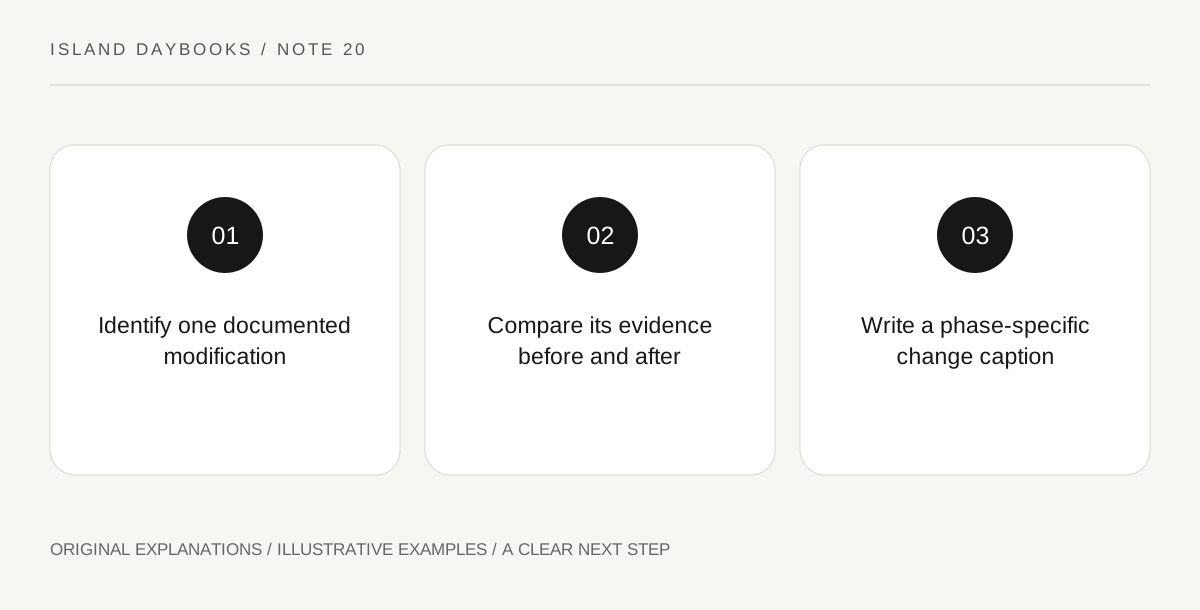
Original explanatory diagram. Read the full method and limitations below.
Start with the long development in the source
UNESCO identifies St George and related fortifications as an ensemble illustrating military engineering across several centuries, including adaptation to changes in artillery. That supports a question about change rather than an untouched original design. Choose a particular interpreted component through official information. The ensemble title does not date every wall or give every building the same visitor arrangement. Record the selected subject and the specific phase or modification the interpretation discusses.
Make a before-and-after claim only when supported
Use an official plan, image or explanation that identifies the change. Write what is established about the earlier arrangement and what is established about the later one. If one side is reconstructed or only partly known, label it accordingly. Do not infer an original layout simply by mentally removing material that looks newer. A change log can be useful even with a single well-documented entry, because it makes the basis for the comparison explicit rather than allowing an attractive drawing to stand in for evidence.
Describe the architectural consequence
Select one visible relationship relevant to the documented change, such as an opening, boundary or addition identified by the interpretation. Explain how the source connects that feature to adaptation. Avoid supplying weapon-handling, firing calculations or a tactical reconstruction. The educational subject is how a built place changes in response to new requirements, not how to operate the equipment associated with it. Where the reason for a particular feature remains uncertain, keep the uncertainty instead of assigning a convenient military purpose.
Write a caption with a verb of change
End with a sentence that uses an evidence-based verb such as modified, extended or replaced, only where appropriate to the actual interpretation. Follow it with the phase and limit of the claim. This gives a Bermuda cultural day a more specific historical outcome than a general description of old defenses. The ensemble becomes a record of responses over time, while a traveler’s observation remains one bounded example rather than a claim to explain every fortification around the islands.
Illustrative island notebook
Illustrative change log: a visitor selects one officially interpreted modification and records the earlier and later arrangements with their evidence types. A reconstructed portion is clearly labeled. The final caption describes the documented adaptation without dating neighboring walls by appearance. It contains no equipment-operation instructions or suggestion that every associated fort can be entered under the same terms.
Questions that come up
Can all parts of a fort be assigned its founding date?
No. The cited ensemble is notable for development and adaptation. Individual components require their own evidence.
Does this exercise require understanding weapon operation?
No. It studies the interpreted architectural consequence of change and supplies no operational or tactical instructions.
References and scope
These sources support the factual background. Examples and exercises are original illustrative teaching material. References do not imply endorsement.
- UNESCO: Historic Town of St George and Related Fortifications, Bermuda — The fortifications’ multi-century development and adaptation to artillery changes; no individual unverified phase date or operational instruction.