Dominica’s volcanic features: read a geological name without turning it into an activity
A name such as hot spring or boiling lake can make a geological feature sound like a holiday activity. In Dominica’s Morne Trois Pitons interpretation, keep the feature’s scientific description separate from any possible visit. A useful island-day study explains what the landscape account identifies without treating a suggestive name as an invitation to bathe, approach or follow an improvised route.
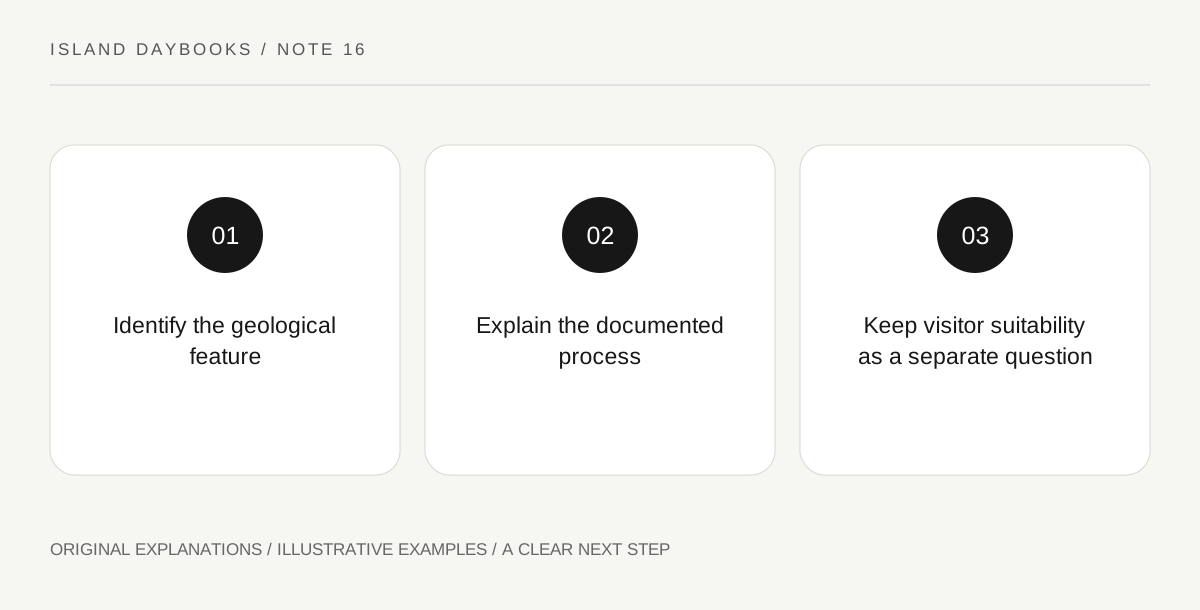
Original explanatory diagram. Read the full method and limitations below.
Give the geological account its own purpose
UNESCO describes Morne Trois Pitons National Park through tropical forest, volcanic landforms, deeply cut valleys and geothermal features. Those subjects explain natural significance; they do not establish participant suitability or access to a particular place. Choose one officially interpreted feature and record its name and the context supplied. Leave a map pin outside the itinerary until actual arrangements are established. The educational question can be answered from an authorized display or official account without physically approaching the feature.
Separate name, process and visitor decision
Make three columns. The first contains the feature’s supplied name. The second summarizes the geological process or characteristic actually explained by the source. The third remains a question about the current visitor format rather than a presumed activity. This prevents language from doing too much work. A water-related name does not establish usable temperature, chemistry, stable ground or permission. Do not fill those fields from a photograph or a remembered experience at a different island’s attraction.
Read the forest and landform together
Choose one relationship identified in the official landscape account, such as forest occurring within a volcanic setting. Describe that relationship without assuming the forest makes every landform benign or that a dramatic feature explains all biodiversity. If you use an image, identify which part it actually documents. A conceptual diagram may connect the interpreted elements, but label it non-navigational. The task is to understand a combination of natural features rather than turn a small image into a terrain assessment.
Finish with a feature explanation and a clear limit
Write a short paragraph explaining the selected geological subject in ordinary language, followed by the practical question still requiring a responsible current provider or authority. Keep the two sentences distinct. This is a complete learning outcome for an island day, even if no excursion follows. It replaces the urge to collect dramatic feature names with a more useful understanding of what those names describe. The landscape remains scientifically interesting without becoming a list of activities a travel article has implicitly approved.
Illustrative island notebook
Illustrative worksheet: a traveler places an officially named geothermal feature in the first column and the source’s geological explanation in the second. The third column asks about authorized visitor arrangements and remains unanswered until an appropriate source responds. An image is labeled interpretive context, not route evidence. The traveler makes no bathing assumption and does not assign conditions from another island to this feature.
Questions that come up
Does hot spring mean a place is suitable for bathing?
No such conclusion follows from the name. This article provides no bathing or approach advice; actual conditions and permissions require appropriate current information.
Can the subject be understood without an outdoor excursion?
Yes. A focused official explanation can answer the geological question. Physical access is a separate matter, not the measure of educational value.
References and scope
These sources support the factual background. Examples and exercises are original illustrative teaching material. References do not imply endorsement.
- UNESCO: Morne Trois Pitons National Park — The park’s forest, volcanic landforms and geothermal features; no water-use, approach, terrain or activity-suitability assertion.