Ibiza’s marine heritage: put the seagrass habitat back into the blue-water image
An island photograph can make the sea look like an empty colored surface. Ibiza’s marine heritage offers a different subject: the habitat beneath and around that surface. Use official interpretation of Posidonia seagrass to examine how a scenic view can conceal ecological structure, without treating the article as a snorkeling plan or a guide to identifying plants underwater.
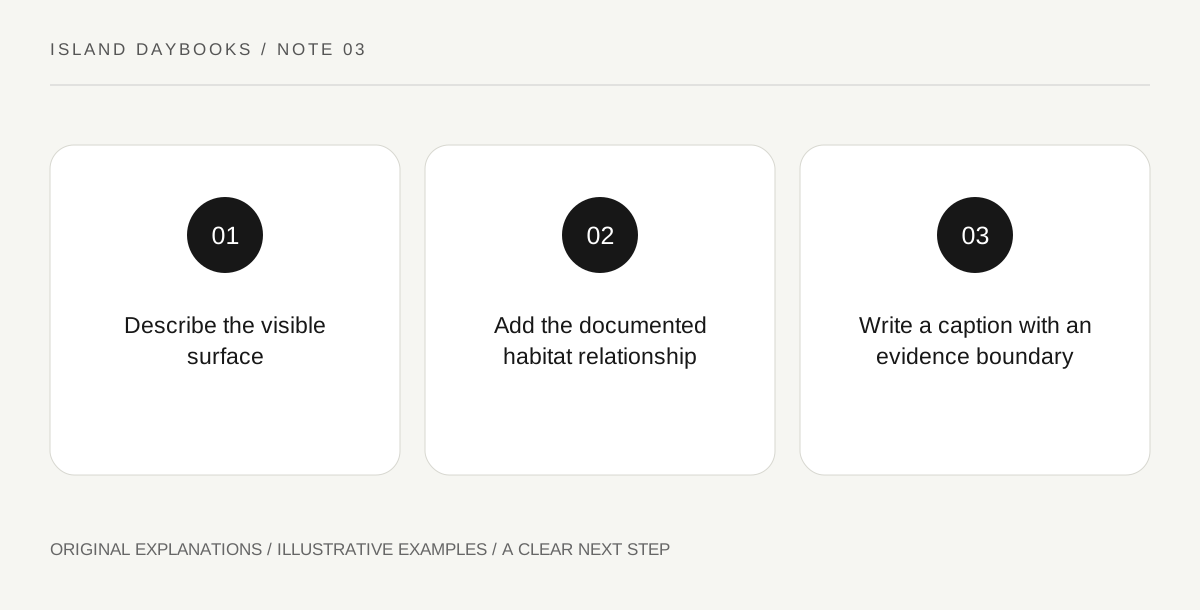
Original explanatory diagram. Read the full method and limitations below.
Start with the named habitat
UNESCO’s Ibiza account identifies Posidonia seagrass meadows as important to marine diversity and emphasizes interaction between coastal and marine ecosystems. That is the narrow ecological foundation for this exercise. Write the habitat name and the relationship stated by the source. Do not infer its presence beneath a particular holiday photograph simply because the water looks clear. A scenic image and a habitat record answer different questions, and visual attractiveness is not a reliable ecological survey.
Make a surface-and-habitat page
Divide a page into what the photograph shows and what interpretation adds. In the first field, describe the actual visible surface, shoreline or view. In the second, record the documented habitat relationship. Keep the two fields distinct rather than drawing unseen plants beneath an unverified location. The exercise can use an official interpretive image or diagram, making its status clear. It asks how ecological knowledge changes a view, not whether the traveler can personally inspect every component of the ecosystem.
Replace a scenery adjective with a relationship
Take a phrase such as beautiful water from a draft caption and add a specific supported ecological sentence. Explain what the interpretation identifies about habitat and diversity without inventing species counts, current condition scores or a guaranteed animal encounter. If the source does not establish the condition of a particular place today, say nothing quantitative about it. This change turns appreciation into a more informative account while keeping the limits of a broad heritage description visible.
Let understanding guide the kind of visit
Choose an educational encounter that can answer the question, such as an appropriate official exhibition, interpretation or qualified provider’s explanation. A water activity is a separate decision with its own current arrangements and participant assessment. Do not enter or disturb habitat to verify a notebook hypothesis. End with a caption explaining what the surface view could not reveal alone. The island day then includes a specific ecological idea, and the sea remains a living environment rather than a decorative background for the traveler’s itinerary.
Illustrative island notebook
Illustrative caption: a visitor starts with a general blue-water image, then adds a separately sourced note about Ibiza’s Posidonia habitat. They explicitly avoid claiming that the plant lies beneath the exact photographed spot. A current educational resource becomes the next inquiry, while a proposed snorkeling activity remains a separate booking question rather than an assumed way to confirm the habitat record.
Questions that come up
Does clear water prove a healthy seagrass meadow is present?
No. A surface appearance does not establish habitat identity or condition. Use appropriate ecological evidence for those claims.
Must I enter the water to understand the subject?
No. Good interpretation can answer a bounded educational question. Any water activity requires its own actual arrangements and conservation instructions.
References and scope
These sources support the factual background. Examples and exercises are original illustrative teaching material. References do not imply endorsement.
- UNESCO: Ibiza, Biodiversity and Culture — Posidonia seagrass meadows, marine diversity and coastal–marine ecosystem interaction; no local habitat identification or current-condition claim.