New Caledonia’s lagoons: draw habitat connections instead of one reef icon
A reef image can become shorthand for an entire island marine environment. New Caledonia’s lagoon heritage asks for a broader picture that includes associated habitats. Use the official description to build a conceptual habitat diagram, keeping ecological connection separate from a proposed swimming route, a species checklist or an assumption that every part of the system is visible in one excursion.
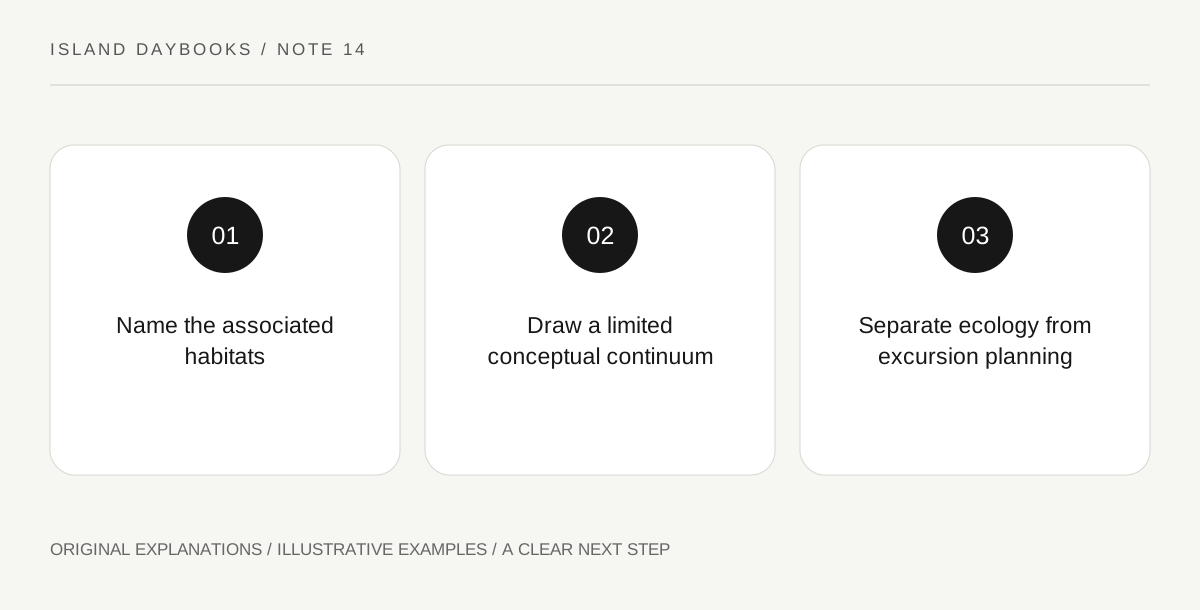
Original explanatory diagram. Read the full method and limitations below.
Read the associated ecosystems in the title
UNESCO describes the Lagoons of New Caledonia through marine clusters representing reef diversity and a continuum that includes mangroves and seagrasses. Those habitat relationships are the narrow basis for this exercise. Write the named habitat types before selecting an image. Do not assume a single photograph shows the entire continuum or that every component of the serial property contains an identical arrangement. A broad heritage account identifies significance, while local ecological details require appropriately specific interpretation.
Make a conceptual relationship diagram
Place the habitat names supplied by the source on a page and connect them only in the general way the explanation supports. Label the diagram conceptual, not to scale and not a route. Its purpose is to prevent the reef from becoming an isolated symbol. Do not add current animal locations, water depths or travel distances from memory. A clean diagram with a few accurate relationships is more useful than a detailed marine map that a traveler is not qualified or equipped to produce.
Give each image a bounded evidential role
If you use official photographs or interpreted views, state which habitat or relationship each image actually documents. A mangrove photograph does not independently establish the condition of a distant reef; a reef image does not prove a particular animal will be encountered. Keep date and location information where available. The exercise is about connected environments, not a promise of a complete ecological survey during a holiday. Questions about current condition should go to appropriate scientific or management information rather than visual guesses.
Choose learning before activity assumptions
An authorized interpretation or educational provider can help answer the habitat question without requiring a water activity. If an excursion is separately considered, establish its exact format, participant needs and conservation requirements through the actual provider. End with a caption explaining why associated habitats matter to the way the property is understood. Leave operational decisions outside the diagram. The island day gains a more coherent ecological subject while the conceptual line between habitats remains an explanation rather than an invitation to travel through them.
Illustrative island notebook
Illustrative diagram: a traveler uses UNESCO’s named habitat types to draw a partial conceptual continuum. Official images receive their actual habitat labels, and no species encounter is attached to the lines. The caption explains why a reef-only icon is incomplete. A proposed boat or swimming activity remains a separate inquiry with an actual provider instead of being treated as the physical version of the diagram.
Questions that come up
Is the diagram a snorkeling or boat route?
No. It represents a limited ecological idea and contains no operational information about water, access or participant suitability.
Does a serial property mean every cluster looks the same?
No. The account concerns diversity across the property. Use specific local interpretation for the place or component you are considering.
References and scope
These sources support the factual background. Examples and exercises are original illustrative teaching material. References do not imply endorsement.
- UNESCO: Lagoons of New Caledonia, Reef Diversity and Associated Ecosystems — The serial marine property and mangrove–seagrass–reef habitat continuum; no condition survey, species encounter or water route.