Singapore Botanic Gardens: ask what makes a planted landscape a scientific collection
A botanic garden can feel like a park until labels and interpretation reveal a different kind of organization. At Singapore Botanic Gardens, study how one interpreted plant or planting belongs to a scientific and educational institution. The question moves beyond whether a specimen is attractive, while avoiding identification guesses, medicinal advice or assumptions that every collection is publicly accessible.
Original explanatory diagram. Read the full method and limitations below.
Read the institution behind the landscape
UNESCO describes Singapore Botanic Gardens as a historic tropical botanic garden that developed into a scientific institution used for conservation and education. Its account connects the landscape with research and plant cultivation history. That context gives a reason to read labels and interpretation rather than treating all plantings as scenery. Select a publicly interpreted subject through current official garden information. The heritage description does not establish that every named collection, research space or building is open during your visit.
Give one label a specific question
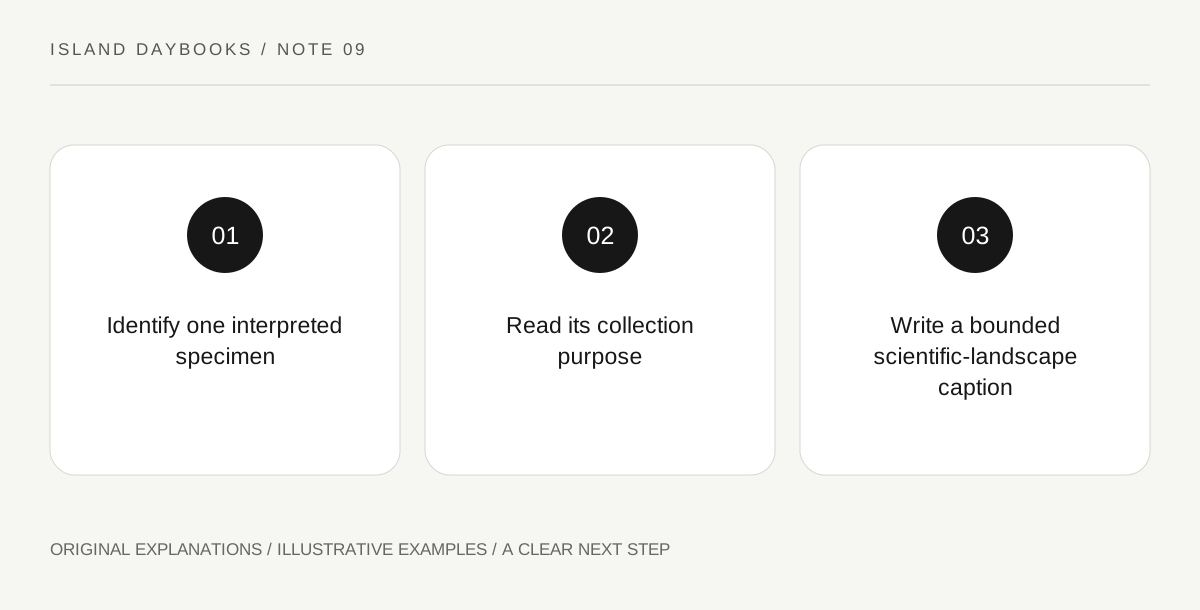
Choose an appropriate labeled specimen or interpreted planting and record the identification exactly as supplied. Note which information the label provides and which it does not. A name can identify a specimen within a collection without explaining its full ecological or historical role. Do not taste, collect or handle plant material to verify an interpretation. The notebook exercise is observational and source-based. If an identification is unclear, retain the label reference and ask an appropriate garden resource rather than applying a familiar-looking common name by guesswork.
Connect the specimen to a collection purpose
Look for official interpretation explaining why the selected subject matters within the garden’s work. It may concern conservation, education or a particular historical inquiry, depending on the actual display. Record only the supported connection. Avoid turning a plant’s history into a health claim or assuming that scientific importance implies a household use. The useful change is seeing a specimen as part of an organized collection with records and questions, rather than as an isolated decorative object whose value is established by its appearance.
Write a collection-based caption
End with the specimen or planting’s supplied identity, the interpreted institutional purpose and one remaining question. Keep the broad garden history distinct from the specific record you studied. A short visit can produce a coherent example without claiming to understand the entire collection or its research. This gives a Singapore island stop an educational subject that can stand alongside other holiday activities, while the living plants remain under the garden’s care rather than becoming materials for a visitor’s experiment.
Illustrative island notebook
Illustrative record: a traveler copies a brief official specimen identifier and reads the associated interpretation. Their caption connects that subject with an explained collection purpose and leaves an unaddressed origin question open. The traveler does not infer a medicinal use, collect a leaf or imply access to a research facility. The notebook describes a scientific collection encounter rather than a personal plant-identification test.
Questions that come up
Does every plant label explain the specimen’s entire significance?
No. A label may provide identification while further interpretation supplies context. Distinguish what each source actually establishes.
Does a scientific plant collection imply medicinal usefulness?
No. Do not infer a treatment or household use from collection status. This article provides no plant-use advice.
References and scope
These sources support the factual background. Examples and exercises are original illustrative teaching material. References do not imply endorsement.
- UNESCO: Singapore Botanic Gardens — The garden’s development as a scientific, conservation and educational institution; no plant identification, medicinal or current-access claim is supplied.