Vallée de Mai: let the famous coco de mer lead to a forest question
A famous seed can become such a strong island symbol that the forest supporting it disappears from the visitor’s account. At Vallée de Mai on Praslin, begin with the coco de mer and deliberately widen the question. Use the reserve’s own interpretation to connect an iconic organism with the community of plants and ecological relationships around it.
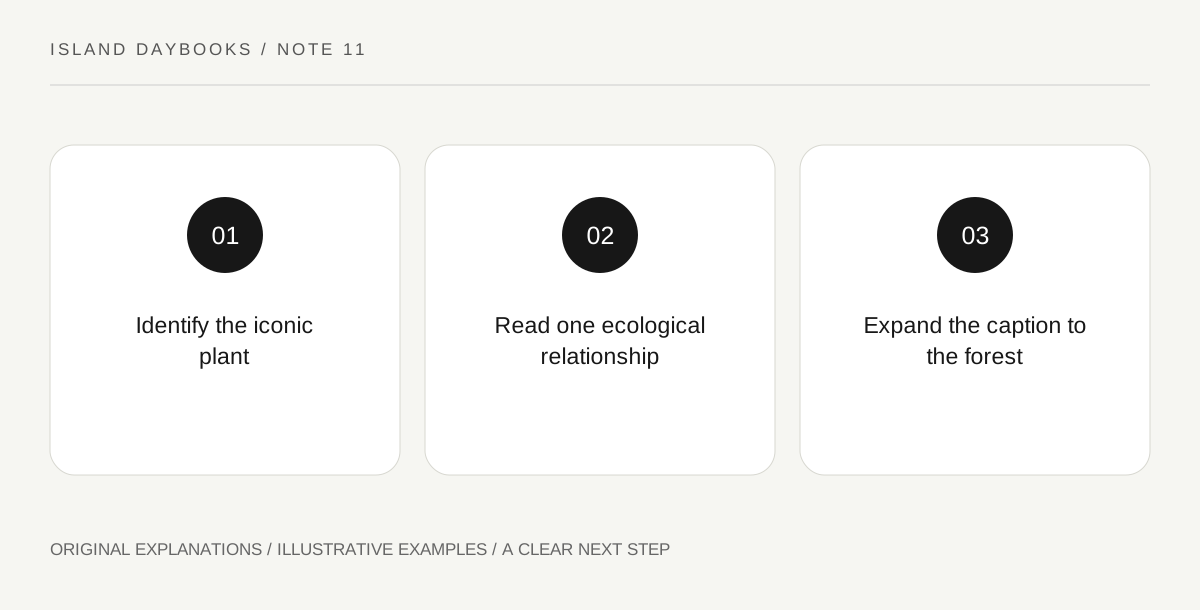
Original explanatory diagram. Read the full method and limitations below.
Start with the reserve rather than the souvenir image
Seychelles Islands Foundation describes Vallée de Mai as an intact palm-forest stronghold for coco de mer, alongside other endemic palms and ecological processes such as pollination and seed dispersal. This gives the visit a broader subject than the famous seed’s appearance. Record the operator’s exact identification and the forest context. Do not infer a plant’s identity from a decorative object or assume that an image in a shop documents where a particular specimen grew.
Choose one relationship from the interpretation
Select a reserve display or official explanation that connects plants with an ecological process. Write the named participants and the relationship actually stated, leaving unspecified roles blank. A general reference to pollination does not identify every pollinator in a particular scene, and a bird photograph does not prove a seed-dispersal relationship. The exercise rewards careful connection rather than a long species list. It can be completed through appropriate interpretation without handling seeds, approaching wildlife or stepping away from the authorized visitor area.
Make the icon one part of a larger diagram
Draw the coco de mer as a labeled node, then add only the other elements and connections supported by the chosen account. Keep the diagram conceptual. It is not a complete food web or a claim that all relationships happen visibly during a short visit. Ask which important process a still photograph would fail to show. That question can change how you understand a forest: the value lies not only in large or unusual objects but also in interactions that require time and interpretation to recognize.
Write a caption that expands rather than abandons the symbol
End with a paragraph that names the iconic plant and one supported ecological connection. Avoid replacing one oversimplification with a claim that you now understand the whole ecosystem. Respect the reserve’s actual photography, handling and route instructions. The notebook should show how a familiar island emblem became an entry point to a more precise question. A Praslin day can then retain the memorable seed while giving the living forest its own place in the story.
Illustrative island notebook
Illustrative diagram: a visitor starts with an official coco de mer identification and adds one ecological relationship explained by the reserve. A separate bird image remains unconnected because its role is not established in the selected account. The final caption describes a partial conceptual diagram, not a complete ecosystem survey, and includes no claim of handling a seed or encountering a particular animal.
Questions that come up
Does a famous seed explain the entire forest’s significance?
No. It can provide an entry point, while the reserve’s ecological interpretation adds relationships and other organisms that the symbol alone does not convey.
Can any nearby animal be assigned a pollination or dispersal role?
No. That relationship needs appropriate evidence. Presence in the same place or image is not enough.
References and scope
These sources support the factual background. Examples and exercises are original illustrative teaching material. References do not imply endorsement.
- Seychelles Islands Foundation: Vallée de Mai — Coco de mer within the endemic palm forest and stated ecological processes; no invented species interaction, encounter or current access detail.