Le Morne, Mauritius: place freedom and memory before the panorama
A mountain beside the sea can be marketed as a dramatic view while its human significance receives only a passing sentence. At Le Morne, begin with the interpretation of refuge, freedom and memory. The educational task is to understand the landscape’s documented meaning without treating a climb, a reenactment or an invented story of suffering as necessary to the encounter.
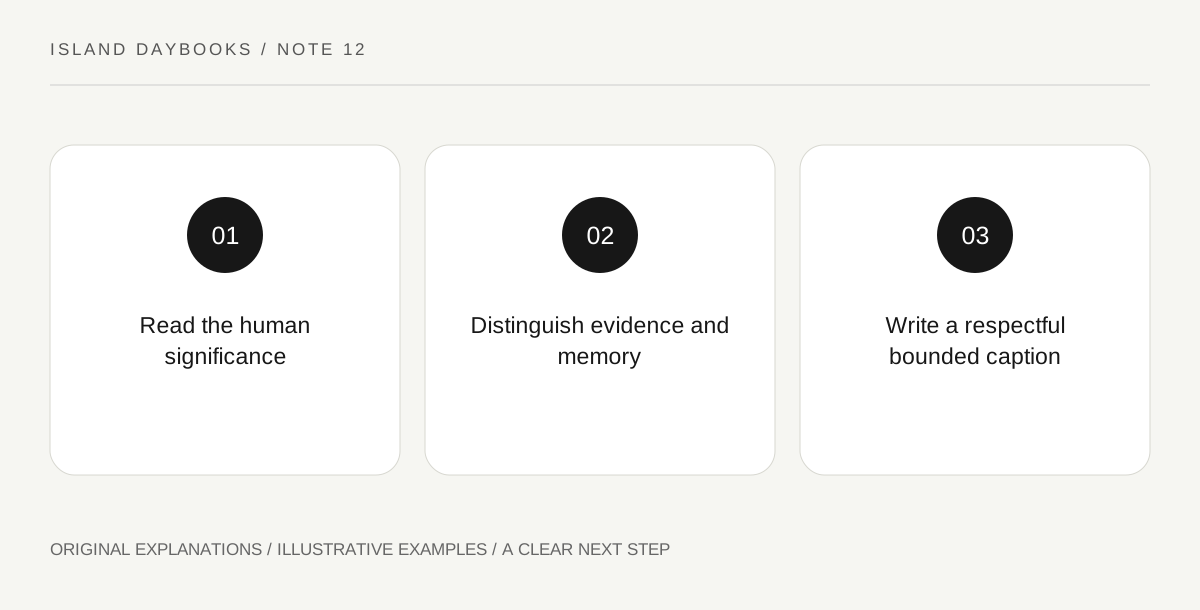
Original explanatory diagram. Read the full method and limitations below.
Read the landscape’s stated significance
UNESCO identifies Le Morne as a refuge associated with people who escaped enslavement and connects its oral traditions with the struggle for freedom. That account should shape the question before a scenic image shapes the itinerary. Record the historical subject in clear, respectful language. Do not reduce people to an adventurous hidden-community story or assume every dramatic legend circulating online is established by the heritage description. The source provides a meaningful context while specific narrative claims still require their own evidence.
Distinguish landscape evidence from commemorative meaning
Make separate notes for the physical setting described by the source and the meanings attached to it through interpretation and memory. The two are related, but a photograph of a slope does not independently establish an individual’s experience. Likewise, a commemorative statement has a different role from an archaeological record. Keeping these categories visible helps a traveler engage seriously without demanding that one kind of evidence perform every job. It also discourages the urge to make the scene emotionally complete by adding details not supplied by the account.
Choose a respectful mode of learning
Use authorized interpretation, a responsible cultural visit or another appropriate official resource. A summit or remote location is not required to understand the question, and this article provides no trail or terrain advice. Read any supplied photography and conduct guidance in the actual setting. A learning encounter should not require staging an image of escape or treating suffering as a backdrop for a personal achievement photograph. The aim is attention to the people and memory associated with the place, not proving how intensely the visitor experienced it.
Write a caption that preserves the human subject
End with a short account of the supported historical relationship and why the landscape has commemorative significance. State which interpretation informed the note, and leave specific unresolved stories out. The view can remain visually striking while the caption gives it a more responsible purpose. This is a distinct Mauritius cultural inquiry, not a generic scenic alternative to a beach day. Its value lies in keeping freedom and memory central to a place whose meaning extends well beyond the visitor’s photograph.
Illustrative island notebook
Illustrative caption: a traveler studies an authorized interpretation and writes about the landscape’s association with refuge and freedom. They distinguish that meaning from what a distant photograph can visibly establish. An unverified dramatic story is omitted, and no mountain ascent is added as proof of respect. The final note keeps the historical people and commemorative subject at the centre.
Questions that come up
Is a climb necessary for a meaningful encounter?
No. Appropriate interpretation can address the cultural question. Any outdoor activity is a separate decision requiring current local arrangements and qualified guidance.
Can a widely repeated legend be stated as fact?
Only when appropriate evidence supports that specific claim. Repetition or emotional force does not replace verification.
References and scope
These sources support the factual background. Examples and exercises are original illustrative teaching material. References do not imply endorsement.
- UNESCO: Le Morne Cultural Landscape — The refuge of people escaping enslavement and the landscape’s freedom/memory significance; no unverified legend, individual biography or climbing instruction.