Chief Roi Mata’s Domain: read oral tradition and archaeology without collapsing them
An island heritage landscape can carry living traditions as well as archaeological evidence. In Chief Roi Mata’s Domain in Vanuatu, focus on how official interpretation brings those forms of knowledge into relation. The aim is a respectful reading of the stated connections, without inventing a story, treating a burial place as a casual attraction or assuming that a map grants access.
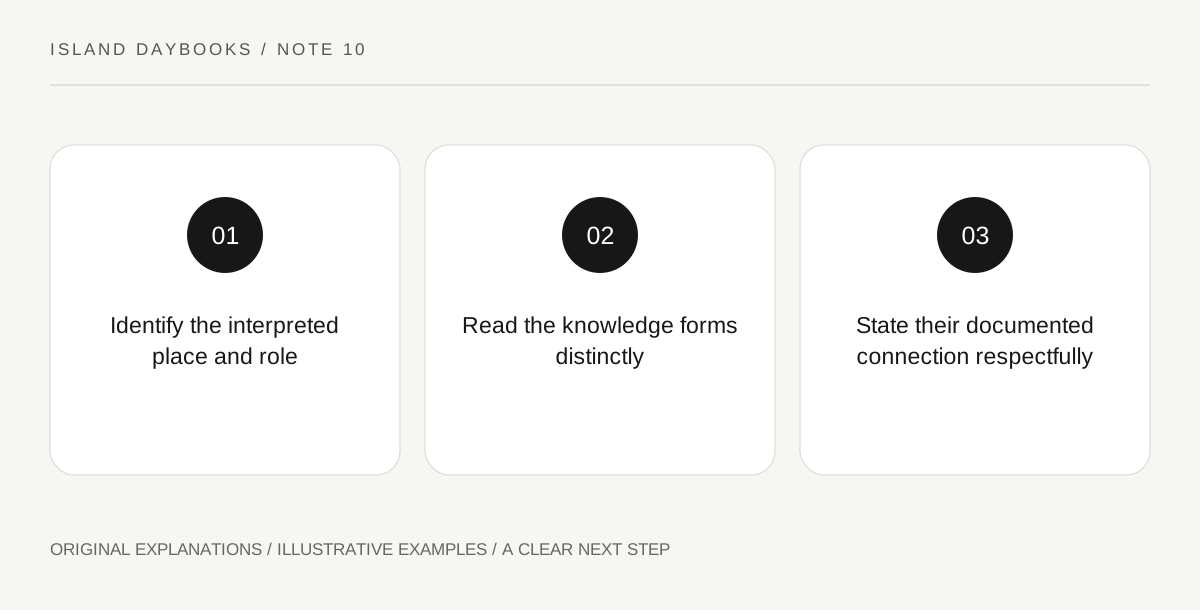
Original explanatory diagram. Read the full method and limitations below.
Begin with the property’s particular account
UNESCO describes three places on Efate, Lelepa and Artok associated with Roi Mata’s life and death, and emphasizes the relationship between oral tradition and archaeology. This provides a subject about knowledge and memory, not simply three scenic stops. Record the named places and the roles identified by the interpretation. The property’s significance does not establish a visitor itinerary, local permission or the appropriate way to engage with a place that has cultural and funerary importance.
Give each source of knowledge its own line
For one interpreted subject, make separate fields for what the oral tradition account conveys and what the archaeological explanation establishes. Use the official presentation rather than inventing a retelling from fragments. The fields need not compete as if one must invalidate the other. They help the reader see how the interpretation connects different evidence and knowledge forms. Where a relationship is not explained in the public account, retain that limit instead of making a dramatic narrative seem seamless.
Preserve people and values in the landscape
Read how the interpretation discusses the chief’s continuing significance and social values. State the specific supported relationship in your own words, without turning it into a universal description of all Vanuatu communities. Avoid quoting or adapting cultural narratives as entertainment detached from their context. A traveler’s account should make clear whose interpretation is being learned from and what remains outside the visitor’s knowledge. Respectful attention can be substantive without claiming the authority to explain a living tradition after a brief encounter.
Choose the encounter through appropriate arrangements
Use the responsible local visitor or cultural authority’s actual current information if considering a visit. Some questions may be addressed through authorized interpretation without approaching every associated place. Keep cultural protocols and photography conditions explicit where supplied. End with a paragraph explaining one documented convergence between tradition and archaeology, alongside the limits of your account. The island day becomes an inquiry into memory and evidence, while the property retains its meaning beyond the traveler’s desire to complete a list.
Illustrative island notebook
Illustrative page: a traveler studies an authorized account of one associated place and records tradition and archaeological interpretation on separate lines. The conclusion states the connection the source actually explains. A possible visit remains dependent on appropriate local arrangements. No invented speech, retold ritual or assumption of burial-site access is added to make the notebook more dramatic.
Questions that come up
Does the heritage map itself authorize entry?
No. Cultural significance and visitor permission are different matters. Establish current arrangements and protocols through the responsible local source.
Must oral tradition and archaeology be treated as competitors?
Not in this exercise. Read how the official interpretation connects them, while preserving what each account establishes and what remains outside its scope.
References and scope
These sources support the factual background. Examples and exercises are original illustrative teaching material. References do not imply endorsement.
- UNESCO: Chief Roi Mata’s Domain — The three associated places and the convergence of oral tradition and archaeology; no invented narrative, cultural protocol or visitor permission.