Villa Romana del Casale: ask what luxury reveals about an estate, and what it hides
A richly decorated villa can be remembered through images of elite comfort while the wider estate disappears. At Sicily’s Villa Romana del Casale, ask how the interpreted luxury relates to the property’s rural context. The exercise keeps decoration, status and work in the same inquiry without inventing the lives of people whose identities the available evidence does not establish.
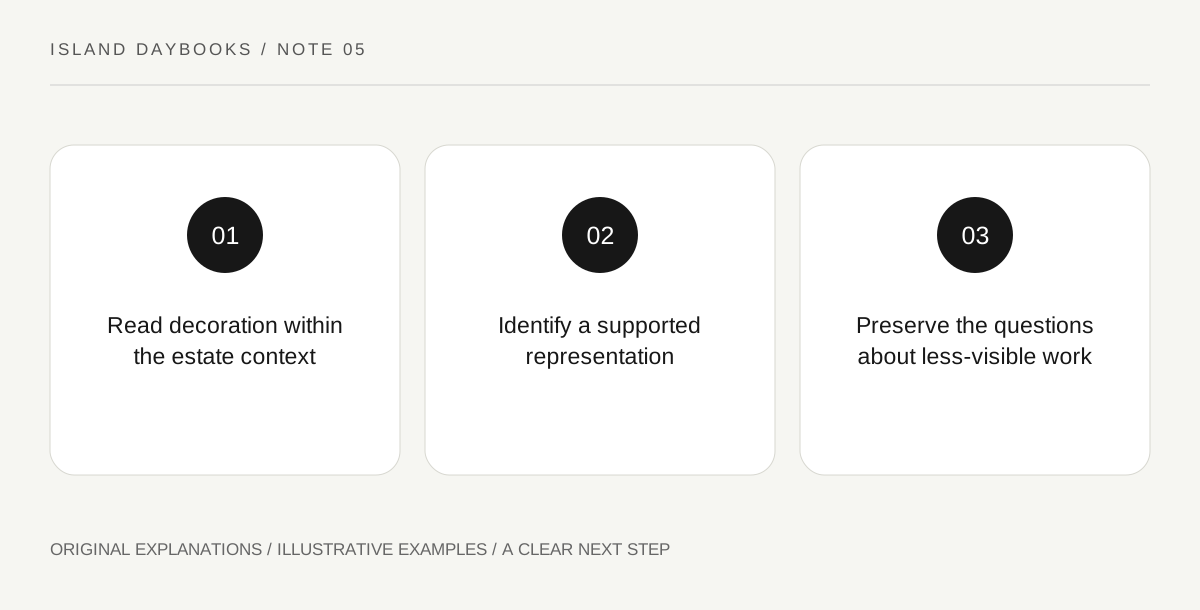
Original explanatory diagram. Read the full method and limitations below.
Read the villa as more than a collection of pictures
UNESCO describes the villa as the centre of a large rural estate and emphasizes the quality and extent of its mosaics. These two points create a productive question: what does the surviving display tell us about an elite setting, and what evidence would be needed to understand the work around it? Record the estate context before choosing one interpreted feature. The mosaics are important, but their visual richness should not silently become the whole social and economic story.
Choose one supported sign of representation
Select a room or feature identified by official interpretation and record the specific claim made about it. Avoid inferring an owner’s precise personality or wealth from decorative abundance alone. Describe a visible choice such as scale, placement or repeated imagery, then ask what the interpretation says that choice can support. Keep an unresolved ownership question unresolved. The goal is to examine how status is represented, with the evidence boundary visible, rather than write a fictional biography for an impressive building.
Put the missing work on a question page
Create a separate list of tasks or roles that you want to investigate, explicitly labeled questions rather than established facts about the site. Look for displays or authoritative research that actually address the estate’s organization. Do not assign a named person, legal status or daily routine to an imagined worker merely because such a story would balance the luxury narrative. A critical account can recognize what the surviving decoration emphasizes and what remains less visible without fabricating the missing history.
Write an account with two evidential weights
End with one paragraph about the interpreted decorative evidence and another about the wider estate question. State which part is supported and which remains for further reading. This gives the visit an independent historical purpose beyond recognizing famous images. The building becomes a place to think about unequal visibility in the record: some surfaces survive magnificently, while other relationships require different evidence. Keeping that distinction explicit is more useful than either celebrating luxury without context or replacing it with an unsupported complete story of everyone who worked there.
Illustrative island notebook
Illustrative note: a traveler studies one officially interpreted decorative feature and links it to the source’s estate context. A second page asks about the work supporting that setting but labels the unanswered questions clearly. The final account gives the surviving evidence its due without inventing a villa owner, a servant’s biography or a precise daily routine absent from the interpretation.
Questions that come up
Can decorative wealth establish an exact owner identity?
No. An identification needs appropriate historical evidence. Do not infer a person merely from the scale or richness of a surviving interior.
Is it useful to ask about labor when the display gives no answer?
Yes, if the gap remains explicit. A focused unanswered question can guide further research without becoming an invented fact about the site.
References and scope
These sources support the factual background. Examples and exercises are original illustrative teaching material. References do not imply endorsement.
- UNESCO: Villa Romana del Casale — The villa as a large-estate centre and its notable mosaic decoration; no invented owner, worker identity or daily routine.