Levuka, Fiji: keep indigenous communities inside the port-town account
A colonial port description can make a town seem to begin when outsiders established warehouses and official buildings. Levuka’s heritage interpretation offers a more specific relationship. Study how commercial development and indigenous communities are presented together, while keeping a visitor’s limited street observations separate from broad claims about local agency, identity or present everyday life.
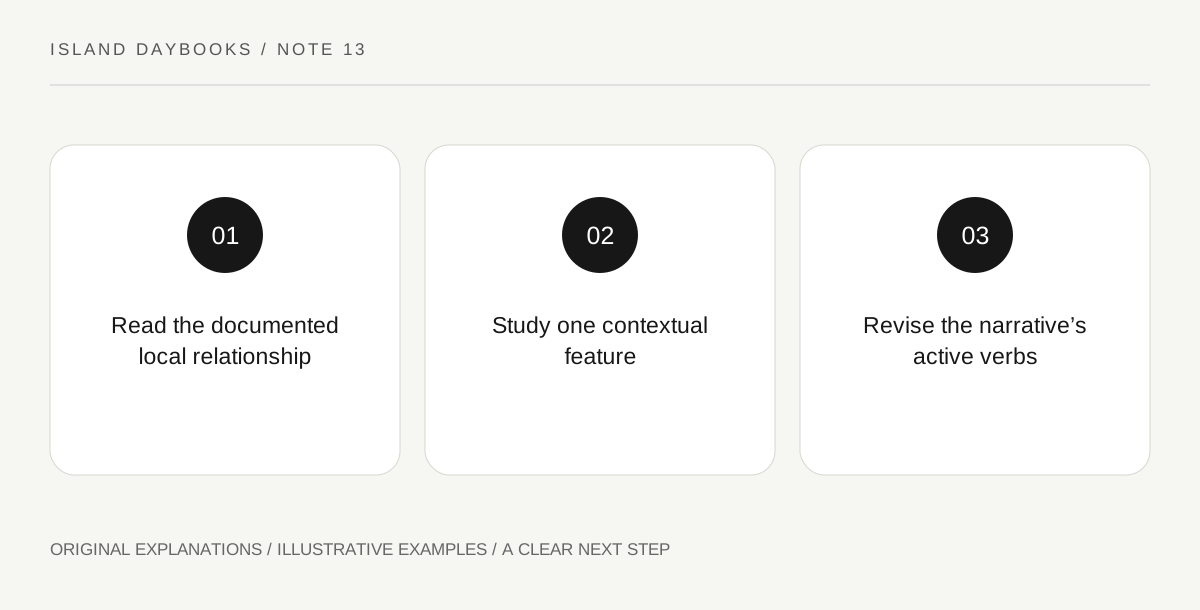
Original explanatory diagram. Read the full method and limitations below.
Begin with the source’s two-sided account
UNESCO describes Levuka as a historic port town whose commercial development occurred around indigenous villages, and emphasizes indigenous influence on its development. This gives a reason to question an empty-island-before-arrival narrative. Record the specific relationship in the source rather than replacing it with a generic colonial-town summary. The account does not mean every building embodies the same mixture of influences, nor does it identify the current occupants or social meaning of every frontage visible during a visit.
Choose one documented urban relationship
Use official interpretation to identify a particular place or feature relevant to the town’s development. Record its stated role, then describe how it relates spatially to the waterfront or neighboring settlement context where that relationship is appropriately visible. Do not assume a present shop front reveals its entire original use. The exercise should connect documented history with one limited observation, not treat every street encounter as evidence that confirms a predetermined story about harmony, conflict or cultural blending.
Notice who receives an active verb
Read your first paragraph and underline the verbs assigned to different people or groups. Does one group build, decide and trade while another merely appears as scenery? Revise the wording where the official interpretation establishes a more active relationship. Do not invent a named decision-maker or assign an intention absent from the source. This is a writing exercise grounded in evidence: it can correct a misleading narrative structure without claiming that the visitor has solved every historical relationship in the town.
Keep the present community outside a historical tableau
Respect current residents, businesses and private spaces. Do not ask people to represent a historical category for a photograph or assume that a quiet frontage is an exhibit. End with a paragraph naming the documented relationship and the particular evidence used. The island day becomes more informative when Levuka is understood as a place shaped by interactions with local agency, rather than a preserved stage set populated only by a colonial timeline. Leave questions about individual buildings for appropriate further interpretation.
Illustrative island notebook
Illustrative revision: a traveler’s first draft says outsiders created the town on an empty shore. After reading the official account, they replace that line with the documented relationship to indigenous villages and influence. A selected urban feature receives a limited contextual note. The revised account invents no individual leader, assumes no current resident’s identity and treats present businesses as part of a living town.
Questions that come up
Can a visitor infer everyone’s historical role from building style?
No. Architectural appearance alone cannot establish identities, decisions or the full history of an interaction. Use appropriate interpretation.
Does correcting a colonial-only narrative require inventing another complete story?
No. A more accurate bounded account can preserve local agency where documented while leaving substantial historical questions open.
References and scope
These sources support the factual background. Examples and exercises are original illustrative teaching material. References do not imply endorsement.
- UNESCO: Levuka Historical Port Town — The port’s development around indigenous villages and indigenous influence; no current identities, invented individual agency or universal building-style claim.