Valletta: choose an institutional question inside a dense historic centre
A concentrated historic city can make every turning seem like another essential stop. In Valletta, let a question about one documented institution set the scale of the visit. The aim is to understand a relationship among purpose, building and surrounding space, rather than using the density of monuments as a reason to fill every available hour with entries.
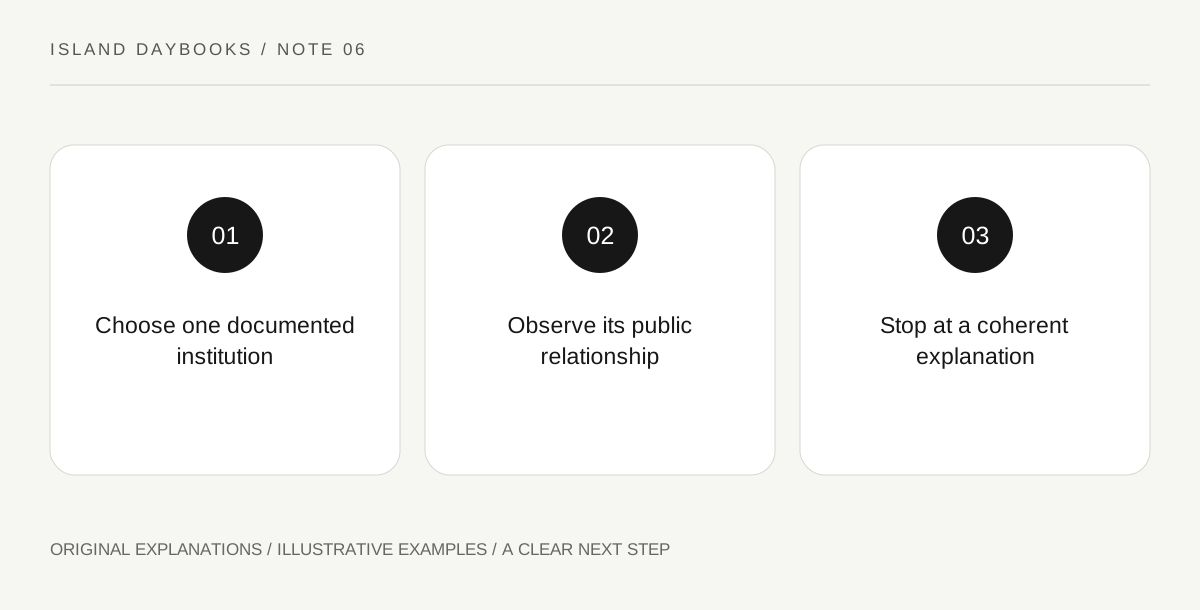
Original explanatory diagram. Read the full method and limitations below.
Replace the monument count with a subject
UNESCO links Valletta closely with the military and charitable Order of St John and emphasizes the concentration of historic monuments in the city. Those points supply context, not a quota for a visitor. Choose one institution or building whose role is explained by appropriate official interpretation. Write the precise subject you want to understand: a documented charitable function, administrative purpose or other supported role. Do not assign the Order’s entire history to every stone building simply because it stands within the same city.
Connect purpose with one spatial relationship
Using the actual visitor information and an authorized position, examine how the selected building meets a street or public space. Describe the entrance, approach or grouping in plain language. Then compare that observation with the institution’s documented purpose. The visible arrangement may raise a useful question without proving a causal design intention. Keep the two evidence types side by side. A grand entrance alone cannot establish every historical use, and an institutional title cannot reveal an interior layout you have not examined.
Give the neighboring context a limited role
Select one adjacent feature only if it helps answer the original question. It might clarify the approach or the relationship to a shared space, depending on what the interpretation supports. Avoid turning proximity into an invented administrative connection. Two buildings beside each other did not necessarily function together in the way a traveler imagines. If the link is unknown, note it rather than adding another paid visit merely to complete a visual pair. The question should guide the scope, not expand automatically with every attractive frontage.
End when the explanation becomes coherent
Finish with a paragraph naming the institution, its supported role and the spatial relationship observed. Add one unresolved question rather than another list of places. A bounded study can be complete even while many monuments remain outside it. This gives a Malta island day a memorable civic subject and makes room for ordinary pauses without treating them as failed sightseeing. The city’s density becomes an opportunity to choose carefully, not an obligation to describe everything as equally essential.
Illustrative island notebook
Illustrative plan: a traveler chooses one officially interpreted institutional building and studies its public approach. A neighboring feature is included only where it clarifies the spatial question. The final explanation states the documented role and observed relationship, leaving a possible connection unresolved. The itinerary does not grow into a monument tally simply because the city contains many important places close together.
Questions that come up
Does a dense historic centre require many interior visits?
No. Let a coherent question and actual visitor arrangements determine the scope. Proximity alone does not make every entry useful for the same inquiry.
Can neighboring buildings be assumed to share a historical function?
No. Establish that relationship through appropriate interpretation instead of inferring it from location or similar materials.
References and scope
These sources support the factual background. Examples and exercises are original illustrative teaching material. References do not imply endorsement.
- UNESCO: City of Valletta — The Order of St John association and concentrated historic-city context; no invented building function or institutional connection.